How to Choose a Professional Kart for Your Business?
Choosing a Professional Kart for your business begins with understanding who will use it and where it will run. A family entertainment center may need easy-to-drive models that handle frequent sessions. A training venue may value responsive steering and predictable braking. The right choice depends on your customers, track layout, operating hours, and available service support—not just top speed.
Look closely at the frame, seat adjustability, tires, brakes, and access to routine maintenance. Ask suppliers for clear specifications, warranty terms, replacement-part availability, and guidance on servicing. If possible, inspect a demonstration model and note how it accelerates, turns, and stops. Small details matter. A kart that feels comfortable during a short test may become tiring after repeated rides. Numbers can mislead.
Compare the full cost of ownership, including consumables, repairs, staff training, and downtime. Ask how the kart performs under the conditions your venue actually faces, such as tight corners or long operating shifts. Check manufacturer documentation and confirm which safety features suit your track and riders. Local operating requirements can differ, so verify them with the relevant authorities or qualified professionals. There is no perfect choice on paper. A spreadsheet will not reveal every vibration, awkward adjustment, or service delay. Treat those uncertainties as reasons to ask better questions, then choose a fleet that balances dependable performance, rider comfort, and practical support.
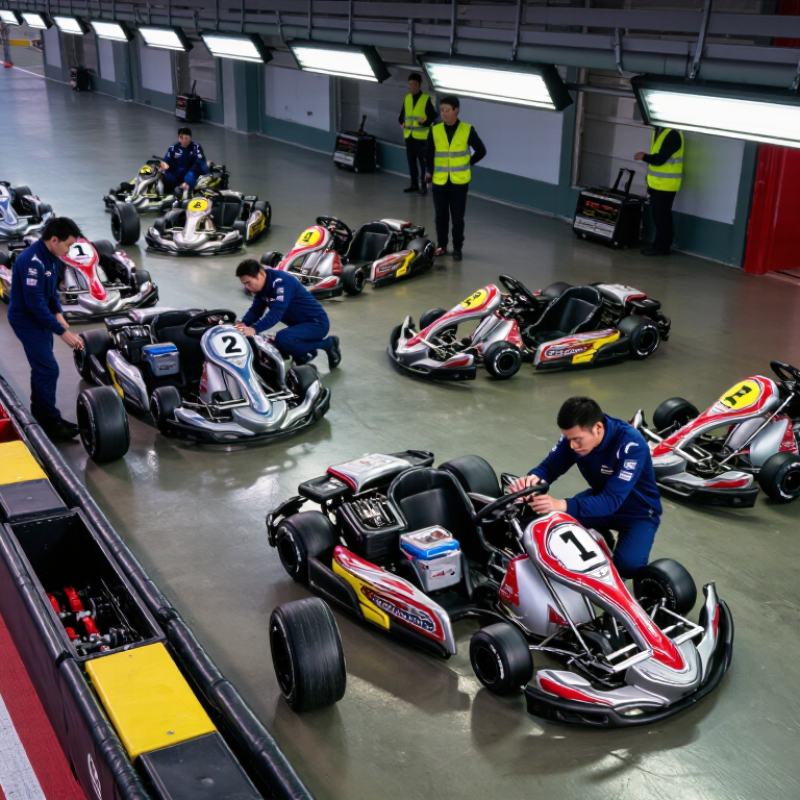
Define Your Business Use and Operating Environment
Before choosing a professional kart, define the work it must do each day. Will it carry tools, move goods, transport staff, or support a customer activity? Estimate the usual load, distance per trip, hours of operation, and number of daily trips. A kart that performs well on short indoor runs may not suit long outdoor shifts. Write down the real routine, not just the ideal one.
Next, map the operating environment. Note whether routes include smooth concrete, rough pavement, ramps, tight corners, wet areas, or narrow aisles. Measure doorways and turning spaces, and consider storage and charging access if the kart is electric. Check the rated payload, braking, tire type, and maintenance needs against these conditions. A specification sheet can look convincing, yet miss a cramped loading bay or a rough patch used every hour. That detail matters.
Tips: Walk the actual route before selecting a model. Photograph tight turns and surface changes. Ask operators what slows them down; their answers may challenge the original plan. Leave some capacity in reserve, but avoid paying for features your work rarely needs. A small trial can reveal problems that planning missed.
Compare Professional Kart Types and Power Systems
Professional karts are not one uniform product; the right type depends on who drives, how often, and where. For public rental tracks, durable single-seat karts with adjustable seating and guarded components are practical. Two-seat models can serve families or instructor-led sessions, but their wider frames need more track space. Junior karts should have reachable pedals, predictable speed limits, and clear separation from faster traffic. Competition-style sprint karts offer sharper handling, yet they require skilled drivers and more attentive upkeep. That trade-off is easy to underestimate.
Power choice changes daily operations. Electric karts offer immediate torque and quieter running, but need suitable charging capacity and battery planning. Gas-powered karts can support longer sessions and quick refueling, but require engine servicing and fuel storage, and create more noise. Neither system is automatically cheaper. Compare energy costs, maintenance hours, downtime, ventilation needs, and access to local technicians. Ask for realistic lap-time and service data based on your expected daily use. Details matter. One caveat: projected savings can look cleaner on paper than during a busy Saturday queue. Test a full operating shift, and track how charging or refueling affects turnaround. Leave room for imperfect forecasts; weather, driver mix, and actual charging habits rarely match a spreadsheet exactly.
Assess Performance, Safety, and Durability Requirements
Choosing a professional kart for a business starts with its duty cycle, not a brochure’s top speed. Estimate laps per hour, session length, rider experience, track surface, and expected days in service. A kart used for short family sessions faces different heat and braking demands from one running near-continuously. Ask suppliers for measured acceleration, stopping distance, and energy use under comparable conditions. Numbers without test conditions are hard to trust.
Safety should be assessed as a system. Check frame stiffness, seat fit, restraint design, steering response, and accessible emergency shutoffs. Then see whether staff can easily reach brakes, tires, and electrical connections. Look for clear inspection intervals and replaceable wear parts. Test with representative drivers, including smaller and larger adults, on the actual circuit. A kart can feel stable in a showroom and twitchy over a rough corner. Easy to miss.
Durability shows up under repeated stress. Examine welds, guards, fasteners, tire wear, and corrosion protection after extended track use, not just a demonstration lap. Request service records or endurance-test data, and compare warranty exclusions with expected operating conditions. If possible, pilot a small fleet for several weeks. Log faults, charging time, and repairs per operating hour. No inspection catches everything; real track use may reveal an overlooked weak point.
Review Regulations, Maintenance, and Total Ownership Costs
A business kart should fit its operating rules before it fits the budget. Check local requirements for track barriers, noise, fire protection, rider age, and insurance; competition rules may not govern rental operations. The FIA Karting Technical Regulations set class-specific limits, including minimum mass and homologated components. Treat them as a technical reference, then confirm which local standards apply. Small details matter.
Build a per-hour cost sheet covering purchase, expected service life, mechanic time, tires, brakes, fuel, storage, and downtime. The U.S. Energy Information Administration reported an average regular gasoline price of about $3.30 per gallon in 2024. At ten gallons weekly, that benchmark equals $1,716 annually, before taxes or delivery. Actual kart fuel costs can differ. The calculation is only a starting point.
Maintenance records should capture engine hours, chain tension, brake wear, tire changes, and repair delays. A loose chain can turn a quick inspection into lost track time. Compare suppliers’ service intervals with your planned daily hours, and price common replacement parts before buying. One spreadsheet line is often missed: spare equipment for busy weekends. That estimate is imperfect; revisit it after a month of real operating data.
Select a Supplier and Match a Kart to Your Business Needs
A professional kart should fit the work your business actually does, not just look impressive in a showroom. Start with your venue: measure track width, turning space, storage access, and charging or refueling areas. Then consider who will drive and how often. A family venue may need easy entry, predictable handling, and adjustable seating. A training facility may value simple controls and quick maintenance. It is tempting to rank top speed first. That can be a poor shortcut.
Choose a supplier that can explain service intervals, warranty limits, spare-parts availability, and operator training in clear terms. Ask for written specifications and a demonstration under conditions close to your own. Check how routine repairs are handled, including who supplies parts and how long common replacements usually take. If possible, compare total operating costs, not only the purchase price. A cheaper kart can become an expensive one when it sits idle.
Tips: Bring your track measurements and expected daily use to supplier meetings. Ask to inspect seat adjustment, brake access, and battery or engine service points. Take notes. One detail is easy to miss: make sure the kart can pass through your actual gates and storage doors. A second opinion from your maintenance staff can reveal practical issues that a sales discussion may overlook.